Statement of Concern: Policing of the ‘Safety in our Hands’ rally
Melbourne Activist Legal Support (MALS) expresses concern regarding the misuse of designated area powers, intimidatory and disproportionate policing and police aggression towards protesters.
On 5 May 2025, a snap rally protesting the harms caused by Victoria Police was held on 9 May in the Naarm/Melbourne CBD starting at 5:00pm. This rally was in response to heavy policing and police uses of force at the Justice for Abdifatah rally in Footscray on 17 April 2025 and the Trans Liberation rally in the CBD on 26 April 2025 (a counter rally to the anti-trans Women Will Speak rally).
On 8 May 2025, Victoria Police announced that the entire CBD would be a designated area under the Control of Weapons Act 1990 (Vic) between 11:59am and 11:59pm on 9 May 2025. Inside a designated area, police have additional powers to search people as well as to request people remove face coverings.
Victoria Police are not required to publish the reasons why a designated area is declared. However, Victoria Police confirmed in media statements that the designated area was declared because of the rally.1
Misuse of designated area powers
The rights to public assembly and political communication remain unchanged regardless of whether or not a designated area has been declared.
Police have the power to search anyone within the designated area for weapons and do not need a warrant nor do they first need to form a reasonable suspicion that a person has a weapon.
While this power is broad, it is still a power that is to be exercised for the purpose of searching for weapons. The power should not be used for the purpose of repressing protest, deterring people from protesting, intimidating protesters, or as an extrajudicial punishment for engaging in protest activity within a designated area.
Searches
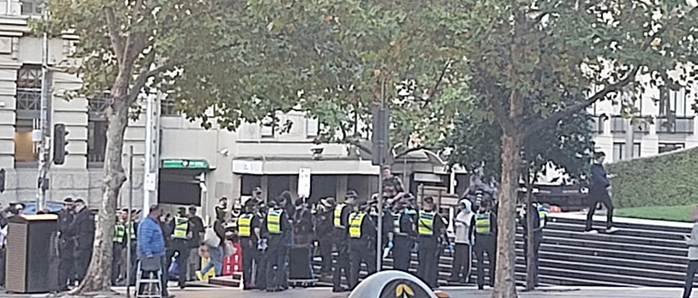
Protesters began arriving to the protest location at approximately 4:45pm. From this time until approximately 5:10pm, police were observed by MALS to be stopping and searching almost every person they believed to be a demonstrator as they arrived on site or immediately upon being noticed by police.
MALS also observed officers ask each other whether particular people had already been searched before conducting a search if the answer was no. Police were observed surrounding protesters with as many as 6 officers being present to search one person. MALS observed that overwhelmingly those being searched complied and were not physically resistant to police searches.
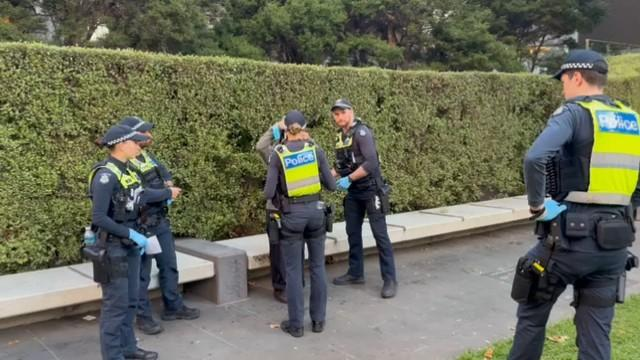
This ratio of police to person being searched was observed by MALS to be intimidating, excessive and unnecessary.2
MALS observed that other members of the public, who were not attending the protest, walking throughout the designated area, including directly through the demonstration, without being stopped, searched or otherwise interfered with by police.
The totality of the above led MALS to form the opinion that the primary purpose of these searches was not to look for weapons but to deter and intimidate protesters.
Face coverings
In a designated area, police may request a person to remove a face covering if they reasonably believe the person is wearing the covering for the primary purpose of concealing their identity or to protect themselves from the use of crowd controlling substances. If the person refuses, police can direct that person to leave the designated area.
In other words, before exercising this power, police must first form that reasonable belief. Furthermore, concealing a person’s identity or protecting themselves from crowd controlling substances is still a permitted purpose for wearing a face covering, so long as it is not the primary purpose.
MALS observed police quickly and automatically approaching anyone arriving at the demonstration wearing a mask or face covering and directing those people to remove the mask or face covering. This led MALS to the opinion that officers were not first forming the requisite reasonable belief before exercising this power and that a decision had been made prior to the demonstration that police would request all demonstrators remove their face coverings.
MALS also observed that police did not allow people to continue wearing face masks for medical reasons. In one instance, after clarifying with the Police Prosecutor who was onsite, an officer informed a demonstrator that health concerns were not a legitimate reason to keep a mask on. In another instance, an officer said to a demonstrator who expressed similar health concerns that “for the safety of those and those around us, we need the mask off”. One officer was observed by legal observers telling a protester, words to the effect of, “if you’re worried about your health, you can leave the area.”
MALS raises concerns that people who are immunocompromised or have other medical needs for wearing a mask are effectively being prevented by Victoria Police from engaging their rights to public assembly and political communication without putting their health in danger.
Everyone has the right to protest, regardless of health or disability status. Not having a functional and effective policy to enable people to wear face masks for medical reasons has a discriminatory effect on people with disability and immunocompromised health conditions and may be a breach of their Charter Rights to public assembly and freedom of expression.
In addition, Victoria Police’s evidence gathering team was present and actively filming speeches and protesters for the duration of the protest, before the march. This, along with the indiscriminate requests to remove face masks and approach to searches, adds weight to the opinion police were using the powers to surveil and intimidate protesters.
Name and address
Police do not have the power to demand a person’s name and address just because that person is within a designated area. This is still the case even if that person is being given a “pat down” search, or is directed to remove a face covering.
MALS observed police asking protesters who were being searched for their names and addresses. MALS observed a search where five officers searched a single person. As one officer conducted a wand search, two observed and two other officers went through the person’s backpack. One officer took out a wallet, handed it to another officer who opened the wallet, took out an identification card and held it up to their body worn camera, before placing it back without the individual noticing. This person was not found to have any weapons and was not interfering with the search.
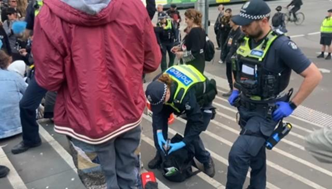
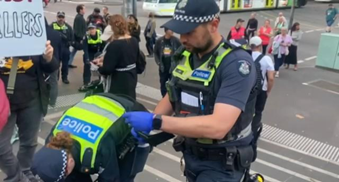
In any interactions with police, there is an imbalance of power in favour of the police officer. It is an abuse of power for police to rely on that imbalance (the legal inexperience of a person, the stress and fear a person is likely to experience in that interaction, the powers police have to use force, any trust a person may have in police to only ask for what they are legally entitled to demand) in order to gather personal information, such as name and address from demonstrators.
MALS did not observe police give any lawful basis for their requests for any protesters name and address, nor observe any lawful basis for them to gather this information without consent.
This unsanctioned information gathering may amount to breaches of privacy and other abuses of power.
Other commentary around misuse of designated area powers
As noted above, the demonstration on 9 May was called partly in response to the police actions against trans liberation protesters from a protest on 26 April. MALS legal observers present at the trans liberation counter protest on 26 April and observed similar misuses of designated area powers at this event.
MALS is concerned about this pattern of discriminatory policing, being used against the same sections of the community.
Excessive police resources
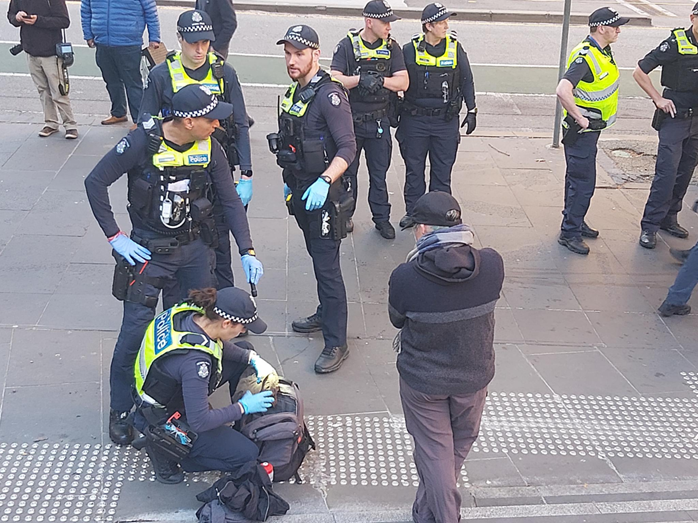
MALS observed there to be approximately 60 to 70 demonstrators and, at it’s highest, 70 to 80 police. This included seven mounted officers, the Public Order Response Team (PORT) Evidence Gathering Team, a PORT tactical commander, police prosecutions, and approximately eight detectives (with two additional Critical Incident Response Team (CIRT) vehicles driving past the protest location multiple times). This meant there was at times at least a 1:1 police to protester ratio. This is one of the highest ratios of police to protesters MALS has observed over the past decade and, in MALS opinion, was serious over- and excessive policing.
At approximately 5:10pm, MALS observed the police numbers to halve and for remaining officers to reposition themselves on the opposite street corners – except for two PORT Evidence Gathering Team officers who remained directly at the protest site, continuously filming protesters.
After listening to speeches, the rally marched through the CBD streets which included walking past Melbourne West Police station. MALS observed approximately 50 police lining the front of the police station and eight detectives.
MALS also observed two specialist PORT transport vans and lines of PORT officers that appeared to be getting into a preparatory formation to physically engage protesters. The protest, after pausing shortly to chant outside the station, continued on its march away from the station and through the CBD.
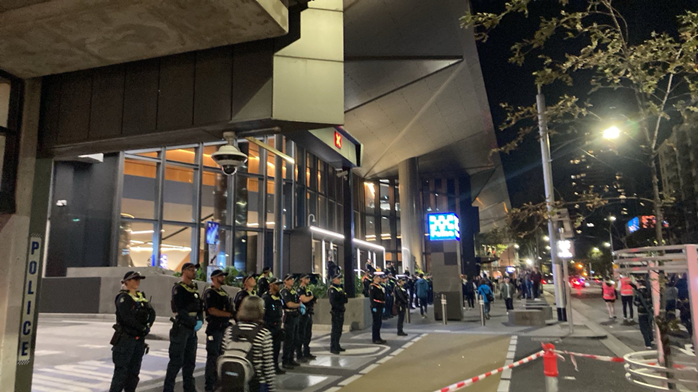
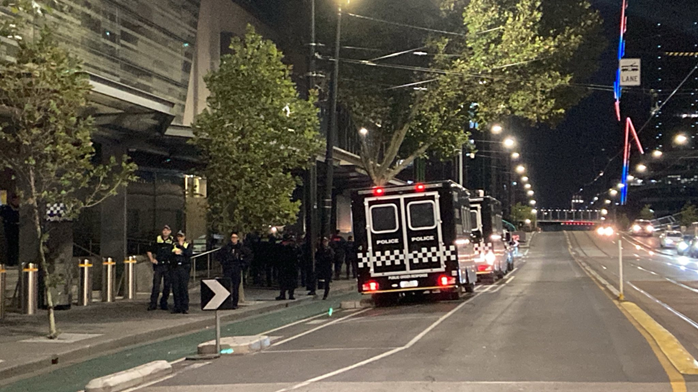
As the rally moved through the CBD streets there was minimal police in attendance. Police presence went from a highway patrol car and two bicycle officers, to two bicycle officers only, to no officers in attendance for the last leg of the march.
It is MALS’ position that the police resources deployed at the beginning of the demonstration and at the Melbourne West Police station to be blatantly excessive. In conjunction with the other concerns raised in this document, MALS formed the opinion the the excessive policing was utilised by Victoria Police to demonstrate a show of force against the demonstration, to create an atmosphere of intimidation towards protesters, and to deter people from public assembly to demonstrate dissatisfaction with Victoria Police.
Aggression towards protesters
In a ‘free and democratic’ society, people should be able to demonstrate, protest, and politically communicate dissatisfaction with any and every government agency. This includes Victoria Police. Police are not immune from, nor should hold any special power to suppress criticism. A protest that is directly expressing dissatisfaction with police or expressing anti-police sentiment should not draw any particular or special response from police.
In the hours leading up to the protest, a police officer, whilst expressing displeasure with the protest and its anti-police sentiment, was quoted in the Herald Sun as saying: “Imagine if we were able to do what these people actually deserve. It’s ridiculous.”3
MALS observed a high level of animosity and aggression from police to protesters from the very beginning of the protest.
Officers were observed approaching and speaking to people in demeaning, aggressive, and intimidating manners. Officers were seen grabbing people on the arm or shoulder who were attempting to walk away from an interaction after complying with requests to remove masks or be searched. These behaviours created an atmosphere of heightened tensions and appeared to be an attempt to generate conflict and intimidate protesters.
For example, MALS observed an officer say to a demonstrator: “I’m telling you for the last time, no face covering, if you do it one more time, you will be arrested. Ok, you will move on now” as he grabbed the demonstrator by the arm. Another officer then approached and calmly stated that it was a designated area and that demonstrators are not being allowed to wear face coverings, but would be allowed to wear it under the chin. As that officer walked away, the first officer said to the demonstrator “this is your last warning” before walking off.
Aggression towards legal observers
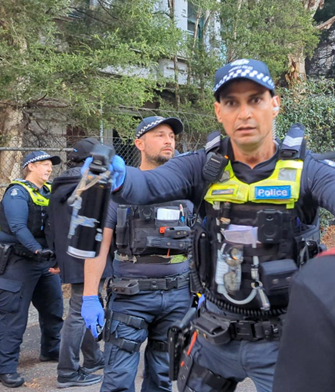
MALS legal observers were largely unimpeded by police in carrying out their role at the protest.
However, there was one incident where a legal observer had an OC canister pointed at their face in a threatening manner. The legal observer was observing and documenting the search of a person who had been forcibly removed from the protest group. The legal observer was not interfering with police and was standing at some distance from officers.
Independent monitoring of the policing of protests is essential for defending the right to organise and participate in public assemblies. The role of legal observers is recognised in the Victorian Police Manual and the practice of independent scrutiny of police is recognised by the UNHRC. The UNHRC describes monitoring as necessary for the exercise of the right to peaceful assembly, emphasising the duties of law enforcement officials to “[protect] journalists, monitors and observers.”4
UNHRC General Comment No. 37 also specifically adds that “[observers] may not be prohibited from, or unduly limited in, exercising these functions, including with respect to monitoring the actions of law enforcement officials. They must not face reprisals or other harassment, and their equipment must not be confiscated or damaged. Even if an assembly is declared unlawful or is dispersed, that does not terminate the right to monitor.”5
Recommendations
MALS urges Victoria Police and all authorities to ensure that:
- Police powers, including designated area powers, are not used intentionally or with the effect of stifling or deterring public assembly and political communication.
- Police powers, including designated area powers, are not misused to surveil and gather personal information of political demonstrators.
- Legal observers are not threatened by police while carrying out their functions as legal and human rights observers.
This Statement of Concern is a public document and is provided to media, Victoria Police Professional Standards Command (PSC), the Independent Broad-based Anti-corruption Commission (IBAC), the Victorian Equal Opportunity and Human Rights Commission (VEOHRC), Government ministers, Members of Parliament, and other agencies upon request.
A downloadable copy of this Statement (PDF) is available HERE.
For inquiries regarding this statement please contact: [email protected]